
A Consumer Guide From a Florida Trial Lawyer
The Florida Commercial Vehicle Accident Guide
What to do when a company's vehicle, a work truck, van, or fleet car, injures you or someone you love.
By David Hughes Harris, Esq. — Trial Lawyer, David Harris Law, P.A., Venice, Florida
Published August 21, 2026 · Updated August 21, 2026
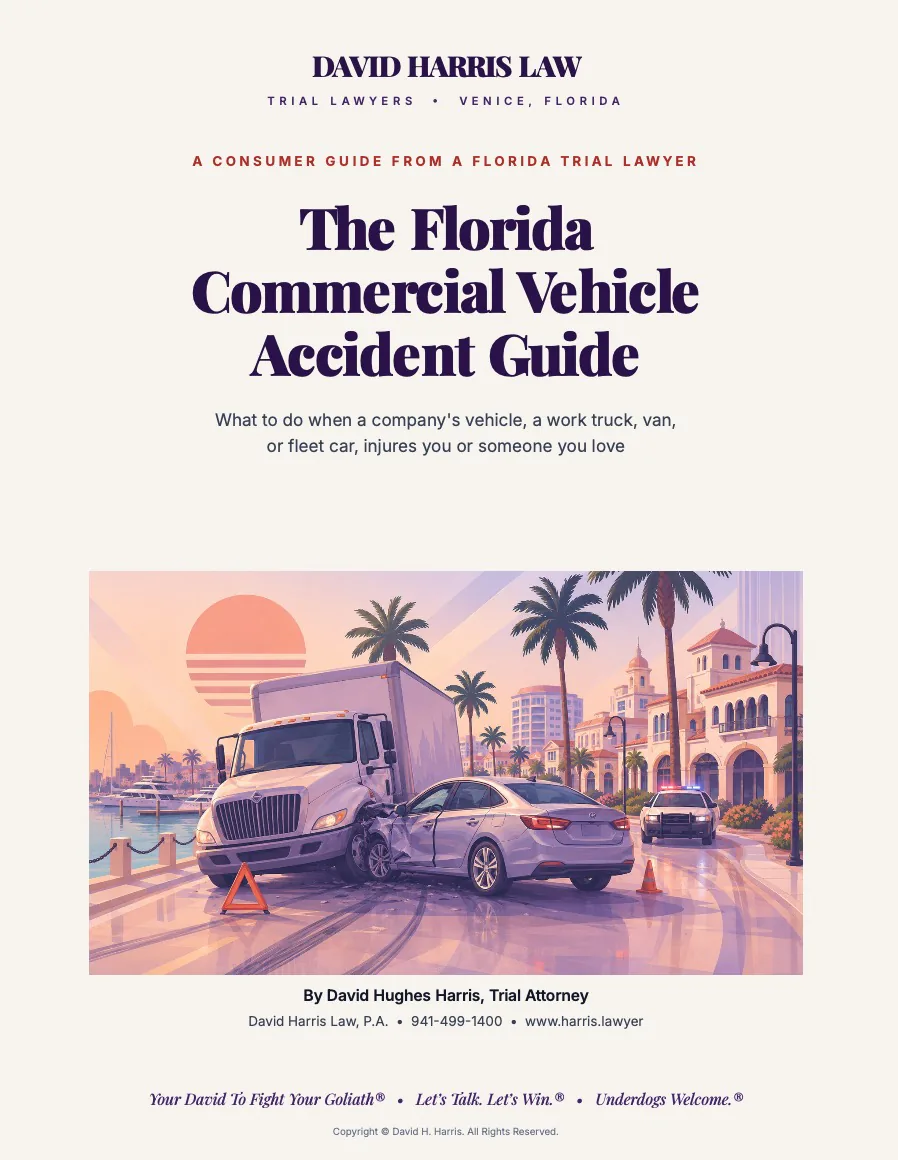
Prefer this guide as a free PDF?
Get the complete, printable 24-page Florida Commercial Vehicle Accident Guide to read offline or share with your family.
Get the Free Guide“You were hit by a business. Your claim deserves to be treated like one.”
Section 1
A Letter From David
Dear Friend,
If you are reading this, the vehicle that hit you probably had a name on the door. A delivery van racing a schedule. A work truck pulling an overloaded trailer. A service vehicle whose driver was reading a dispatch screen instead of the road. A fleet car driven by someone whose employer never should have handed over the keys.
I am sorry you are going through this. I mean that.
Here is what makes your situation different, and why I wrote this guide. When a company's vehicle injures someone, the crash is not just between two drivers. It is between you and a business, and businesses respond to crashes the way businesses respond to everything: with systems, insurance teams, and lawyers. In many companies, the crash was reported to a risk department or insurer before you left the emergency room. Nobody called to tell you that, of course. You deserve to know how this actually works, in plain English, from a trial lawyer who has been handling injury cases since 1995 and who spent years on the insurance defense side before devoting his practice entirely to injured people.
There is another side to that coin, and it is the reason these cases matter so much: businesses carry business insurance. Commercial policies and umbrella coverage often mean real protection exists for people who are seriously hurt, protection that would never exist if the same careless driver had been in a personal car. Finding it, preserving the evidence, and holding the company accountable is what this work is.
Your health comes first. Before you think about claims or compensation, please get the medical care you need and follow your doctors' guidance. Nothing in this guide matters more than your recovery.
Time matters more in these cases than almost any other. Company vehicles carry data that gets overwritten, they get repaired and returned to service quickly, and the company's story gets set early. Some lawyers will push you to sign a contract on the first phone call. That is not how I work, but I will tell you plainly: the sooner someone is protecting your evidence, the stronger your position.
I am selective about the cases I take. I decline far more cases than I accept, because that is the only way I can give each client my personal attention. When you hire me, you get me. This guide is useful to you whether or not we ever work together, and that is the point. I would rather you be informed and protected than uninformed and taken advantage of.
Let's Talk. Let's Win.®
Your friend,
David Hughes HarrisDavid Harris Law, P.A. • Venice, Florida
Section 2
About Your Lawyer
I am a personal injury attorney and trial lawyer. That description matters, because many attorneys who advertise for accident cases rarely (and some never) set foot in a courtroom, litigate claims, or have any jury trial experience. I have tried cases to juries, judges, and arbitrators across a career which began in 1995, and since 2003 I have devoted my practice exclusively to representing injured people and their families.
Earlier in my career I worked at a major firm that defended insurance companies against personal injury claims. I know how adjusters evaluate files, how defense lawyers build their cases, and where they look for weaknesses. Now I use that inside knowledge for one side only: yours.
I founded David Harris Law, P.A. in 2010 to practice law the way I believe it should be practiced: personally, selectively, and all in for every client I accept.
What Your David To Fight Your Goliath® means in practice
- You talk to me, not a case manager you have never met.
- I am open and honest with you about your case from beginning to end, even when the truth is hard.
- I seek your input, answer your questions, and return your calls.
- I prepare every accepted case as if it will be decided by a jury.
- I do not take a fee that exceeds what you receive as compensation. That is my personal commitment to every client.
Education and background
I earned my B.A. from American University in 1991 and my law degree from American University's Washington College of Law in 1995, where I served as Co-Chair of the National Moot Court Team and Lead Oral Advocate in national competition. Before law school I interned in the United States Senate, worked as a research assistant in the United Kingdom's House of Commons, and served as field director for a successful congressional campaign. I have practiced in Florida, Pennsylvania, and New Jersey, in both state and federal courts.
I handle serious injury and wrongful death cases across Southwest Florida, including jury trials and litigation in the state courts of the 12th and 20th Judicial Circuits and in federal court. If you are unsure whether your community is in my service area, call 941-499-1400 and ask. If your matter is outside what I handle, I will do my best to refer you to a lawyer who fits.
“Credentials tell you where a lawyer has been. How he treats you on the first phone call tells you who he is.”
Section 3
Why Commercial Vehicle Cases Are Different
A crash with a company vehicle looks like an ordinary car accident at the scene. Legally, it is a different animal, and the differences cut in both directions.

You are facing a business, not just a driver
Behind the driver who hit you stands an employer, and behind the employer stands a commercial insurer, often a risk manager, and sometimes a rapid-response team whose job begins the moment the crash is reported. Companies document, photograph, and interview quickly, and their version of events gets written while you are still in a hospital gown. The playing field is not level on day one. It can be leveled, but not by waiting.
More rules apply to them
Commercial drivers and vehicles answer to layers of law that private drivers never touch: state insurance requirements for heavier vehicles, federal safety regulations for many interstate operations, licensing requirements for certain vehicle classes, and the company's own written safety policies. Every layer is a standard of care, and every violated standard is evidence. A company that skipped maintenance, ignored its own phone-use policy, or put an unvetted driver behind the wheel has explaining to do.
More coverage usually exists, and more defendants may share responsibility
Florida requires additional liability coverage for commercial vehicles by weight, federal rules require far more for many interstate carriers, and businesses commonly carry umbrella policies above all of it. Just as important, the law may hold more than the driver responsible: the employer, the vehicle's owner, maintenance contractors, and others. Serious injuries deserve every layer of accountability and coverage that actually exists, and finding it all is precisely the job.
The "independent contractor" defense arrives early
Expect it almost immediately in delivery and gig-economy cases: "the driver was an independent contractor, not our employee." Sometimes that is true. Often it is a label the law looks straight through, based on who controlled the work, and even where it holds, other paths to responsibility may remain. Do not accept that sentence as the end of your case. It is usually the beginning of the analysis.
The same Florida rules still govern you
Your own PIP pays first, the permanency threshold still gates pain and suffering in most cases, the two-year deadline from the March 2023 law changes applies, and the modified comparative negligence rule can bar recovery if you are found more than 50 percent at fault. A corporate defense team knows every one of these rules cold. You now know they exist, and that is the start of protecting yourself.
Section 4
The First Days After a Crash With a Company Vehicle
The first days are disorienting in any crash. When a business is on the other side, a few extra steps matter enormously. Here is what to do, in order, and why.

- Call law enforcement and get the crash on record. The report will identify the driver, and critically, it should identify the vehicle's owner and the driver's employer. Make sure your account is heard at the scene if you are able.
- If you feel even remotely unwell, let EMS transport you. Adrenaline masks injuries. Tell the paramedics, nurses, and doctors about every area of your body where you feel pain, because anything undocumented will later be treated as if it never happened.
- Photograph the company identity, safely. The name and logo on the door, any DOT or fleet numbers, the license plate, any trailer markings, and the driver's uniform if visible. Companies sometimes dispute which entity operated a vehicle. Your photos can end that argument before it starts.
- Get medical care within 14 days, no matter what. Florida's PIP law requires initial care within 14 days of the crash, or your no-fault benefits can shrink dramatically, and without a certified emergency medical condition your PIP medical benefit can be capped at $2,500 instead of $10,000.
- Report the crash to your own insurance company. Your PIP claim runs through your own carrier, and your policy requires prompt notice. Reporting is not the same as giving a recorded statement about your injuries.
- Do not give a statement to the company or its insurer. A company representative may call quickly, sometimes with a settlement figure, sometimes just "checking on you" on a recorded line. Every word serves their file. You have no obligation to speak with them. Talk to a lawyer first.
- Sign nothing. Medical authorizations, releases, quick settlement papers. A release signed for a fast check can end your claim forever, before you know how badly you are hurt.
- Preserve your vehicle and start a file. Do not repair your car until it is documented. Keep bills, receipts, co-pays, mileage, and missed work records. Compensation depends on proof, and proof starts now.
- Get legal help early, because their evidence will not wait. The company vehicle's telematics, dashcam footage, dispatch records, and the vehicle itself can be gone or overwritten in weeks. A preservation letter, sent early, changes what survives. This step, more than any other, separates strong commercial vehicle cases from weak ones.
Section 5
The Company's Team Is Already Working
The day your crash was reported, two files were opened: one by the company's insurer, and often one inside the company itself. I know that adds insult to your injuries, but you deserve the truth about it.

Companies are not evil, and neither are their insurers. They are businesses protecting their money and their reputation, and this is the part every injured person needs to understand: their financial interest and yours point in opposite directions, and they started first.
What they are doing right now
- Working the scene while it is fresh. Larger companies and commercial insurers can put investigators and photographers on a serious crash within hours, shaping the record before you have even been discharged.
- Securing their own evidence, on their own terms. The vehicle's telematics and camera footage, the driver's logs and phone, the dispatch records. They know exactly what exists, and unless they are put on legal notice to preserve it, some of it may quietly stop existing.
- Framing the driver's status. Employee, contractor, leased operator, franchisee. The corporate structure gets positioned early, and it gets positioned to their benefit.
- Pulling your history. Your prior crashes, claims, and medical past, through the same industry databases every insurer shares. They may know your history better than you remember it.
- Watching you online. Adjusters and investigators routinely review claimants' social media. A single photo can become the centerpiece of their defense.
- Calling early, sometimes with money. A quick, modest offer while the bills are arriving is not generosity. It is priced on closing your file before the full extent of your injuries, and their exposure, is known.
How representation changes the dynamic
When your claim is handled by an experienced lawyer, one with a track record of honesty, attention to details in evidence, and zealous advocacy in the courtroom and at the negotiating table, your case is treated differently. Preservation demands go out, and the company's evidence comes under legal protection. The recorded statement stops. The contractor label gets tested against the facts instead of accepted. And the evaluation of your claim starts being driven by proof and coverage, not by how quickly they hoped you would sign.
“The company started working the day of the crash. The only question is when someone starts working for you.”
None of this means you must hire a lawyer, or hire me. It means the other side is organized, funded, and early, and you should at least know your options before making decisions that cannot be unmade. The consultation is free: 941-499-1400.
Section 6
What You Must Prove to Win
A commercial vehicle claim is a tort claim: a civil wrong for which the remedy is money damages. Winning one requires proof of three things, plus a fourth question that only exists when a business is involved.
1. Liability: who broke the rules
Every driver owes a duty of reasonable care, and commercial operations owe more: compliance with safety regulations, vehicle maintenance, driver screening and training, and their own written policies. Liability in these cases often has two layers, the driver's conduct behind the wheel, and the company's conduct long before the crash.
2. Causation: connecting the crash to the injury
Your injuries must have been caused, or made worse, by the crash. Expect the defense to comb through years of medical records and hire doctors to testify that your condition was pre-existing or degenerative. An aggravation of a pre-existing condition is still compensable under Florida law, but it must be proven with medical evidence presented the right way.
3. Damages: what the harm actually is
Medical bills past and future, lost income and earning capacity, and the human losses. In most Florida auto cases, recovering pain and suffering from the at-fault side also requires meeting the permanency threshold: a permanent injury, significant and permanent scarring or disfigurement, permanent loss of an important bodily function, or death, generally established through your treating physicians' sworn opinions.
4. Responsibility: connecting the company
This is the question unique to your case. An employer is generally responsible for its employee's negligence when the driver was working within the course and scope of the job. Florida's dangerous instrumentality doctrine separately holds a vehicle's owner responsible for allowing a careless driver to use the vehicle. And a company's own negligence, in hiring, retention, supervision, entrustment, or maintenance, can create direct responsibility beyond the driver's. Proving these connections takes employment records, contracts, and corporate documents that only investigation and, when necessary, litigation will produce.
If any element fails, the case fails, and an honest lawyer tells you that at the first meeting, not after two years of false hope. For an honest read on all four questions in your case, let's talk: 941-499-1400.
Section 7
The Compensation That May Be Available
Every case is different, and no lawyer can tell you what your claim is worth before the facts and the medicine are understood. What I can tell you is the full range of damages Florida law may allow, because injured people routinely settle with companies without ever learning half of this list exists.
Depending on your circumstances, a Florida commercial vehicle claim may include:
- Medical expenses, past and future. Hospital care, surgery, imaging, therapy, medication, equipment, and the care your doctors project for years to come.
- Lost wages. Income you have already lost while recovering.
- Loss of future earning capacity. What your injuries will cost you in earnings, benefits, and opportunity over a working lifetime.
- Physical pain and suffering, past and future, where the permanency threshold or another exception is met.
- Mental and emotional suffering, past and future, including anxiety, depression, and the psychological aftermath that often follows violent crashes.
- Loss of enjoyment of life, past and future. The activities, hobbies, and everyday abilities the injury has taken from you.
- Life care planning. In catastrophic cases, charting and funding the future interventions, therapies, and support a client will need.
- Loss of consortium. The law recognizes that serious injury harms marriages and families, not just the person in the crash.
- Wrongful death damages. Where a crash takes a life, Florida's Wrongful Death Act defines the compensation available to surviving family members.
- Punitive damages, in limited cases. Where conduct rises beyond carelessness, such as an impaired commercial driver, or a company that knowingly kept a dangerous driver on the road, the court may allow a punitive claim on specific proof and with court permission.
What determines the value of a claim
Adjusters and juries look at how the crash happened, the force of the collision, the objectivity of the injuries, what the doctors say about permanency, the wage documentation, and the credibility of the injured person. In commercial cases one more factor joins the list: the company's own conduct. A business that violated safety rules or its own policies changes how every evaluator, especially a jury, sees the case. Cases are won by believable people with provable losses. It simply does not work any other way.
Section 8
Who May Be Legally Responsible
In an ordinary crash, the list of potentially responsible parties is short. In a commercial vehicle crash, it can run deep into the corporate structure, and every responsible party usually means another layer of insurance coverage standing behind your claim. This search is the heart of a commercial vehicle case.
- The driver. The starting point, but in these cases rarely the end.
- The employer. A company is generally responsible for its employee's negligence committed within the course and scope of the job. Deliveries, service calls, errands in the company truck: if the driver was working, the business generally answers.
- The company itself, for its own choices. Negligent hiring, negligent retention, negligent supervision, and negligent entrustment. A business that skipped background checks, ignored a driver's record, tolerated policy violations, or handed keys to someone it should not have can be directly responsible, separate from the driver's conduct.
- The vehicle's owner. Florida's dangerous instrumentality doctrine holds a vehicle's owner responsible for the negligence of a driver entrusted with it. In fleets, the owner and the employer are not always the same entity, and both matter.
- Leasing and staffing arrangements. Leased vehicles, rented trucks, staffing-agency drivers, and franchise structures each bring their own contracts, their own insurers, and their own legal rules, including some federal protections for leasing companies. These layers are exactly where unrepresented claimants get lost, and where careful lawyers find coverage.
- Maintenance providers and cargo loaders. A brake job done wrong or a load secured badly can make an outside contractor responsible.
- Vehicle and parts manufacturers. Where a defect caused or worsened the crash or the injuries.
- Your own uninsured motorist carrier. Not every "company vehicle" is properly insured. Unmarked vans, small operators, and lapsed policies exist, and when commercial coverage fails, your own UM coverage may stand in the gap.
Section 9
Insurance Coverage in Commercial Vehicle Cases
Coverage is where commercial vehicle cases separate most sharply from ordinary crashes. More usually exists, but it hides in layers, and nobody on the company's side will draw you the map.
What the law requires of commercial vehicles
Florida requires heavier commercial vehicles to carry additional combined bodily injury and property damage liability coverage, and federal rules go much further for many interstate operations:
| Vehicle | Minimum liability coverage |
|---|---|
| Commercial vehicles 26,000 to 34,999 lbs | $50,000 per occurrence (Fla. Stat. § 627.7415) |
| Commercial vehicles 35,000 to 43,999 lbs | $100,000 per occurrence |
| Commercial vehicles 44,000 lbs and up | $300,000 per occurrence |
| Many interstate carriers under federal rules | $750,000 or more (49 C.F.R. Part 387) |
| Rideshare vehicles during a ride (TNC law) | $1,000,000 (Fla. Stat. § 627.748) |
Statutory and regulatory minimums, not case values. Actual policies are often far larger, with umbrella coverage above them.
The gap nobody warns you about
Notice what the table does not cover: the ordinary company car, van, utility vehicle, pickup, or fleet sedan under 26,000 pounds. For those, Florida imposes no special liability minimums at all. The State requires PIP and property damage coverage of them like any private car, and nothing more. Legitimate businesses almost always buy substantial commercial and umbrella coverage anyway, because their assets are exposed. But "almost always" is not "always," which is why your own UM coverage still matters even in a commercial case.
How the layers stack in practice
- Your PIP pays first. Florida's no-fault system does not care that a company hit you: 80 percent of medical bills and 60 percent of lost wages up to $10,000, with the 14-day rule attached.
- The commercial liability policy on the vehicle or business answers for damages beyond PIP, subject to the permanency threshold for pain and suffering.
- Excess and umbrella policies sit above the primary commercial policy, sometimes in multiple layers, found through disclosure and discovery, not phone calls.
- Multiple defendants can mean multiple policies, and your own UM coverage backstops the whole structure if the commercial side is uninsured, underinsured, or disputed.
Prefer this guide as a free PDF?
Get the complete, printable 24-page Florida Commercial Vehicle Accident Guide to read offline or share with your family.
Get the Free GuideSection 10
The Vehicles, and What Puts Them in Crashes
"Commercial vehicle" covers far more than the eighteen-wheelers on I-75, which have a guide of their own in this series. This book is about the working vehicles woven through every Southwest Florida neighborhood, and the pressures that put them into collisions. The cause of your crash determines the evidence, and the evidence determines the outcome.

The fleet around you
- Delivery vans and box trucks. Package delivery, food delivery, freight shuttles. Tight routes, constant stops, and schedule software that never says slow down.
- Service and trade vehicles. Plumbing, electrical, HVAC, pool, pest, and landscaping trucks, often towing trailers or carrying ladders and equipment.
- Construction and heavy work trucks. Dump trucks, utility vehicles, and loaded pickups moving between job sites.
- Company cars and fleet sedans. Sales reps, managers, and staff driving on the clock, in vehicles the company owns and controls.
- Rideshare and gig vehicles. Personal cars doing commercial work, with insurance that changes by the minute depending on the app's status.
What actually causes these crashes
- Schedule pressure. Quotas, delivery windows, and route timers translate directly into speed, rolling stops, and risky turns.
- Distraction built into the job. Dispatch screens, navigation apps, and work phones demand attention the road never gets back. When a company's own systems create the distraction, that is evidence.
- Fatigue. Long routes, early starts, and second jobs. Hours and telematics data tell the story.
- Unvetted and undertrained drivers. High-turnover fleets that skip background checks, ignore driving records, or put drivers in vehicles they are not prepared to handle.
- Poor maintenance. Brakes, tires, and lights on vehicles that live hard lives and only earn money while moving.
- Loads and trailers. Overloaded beds, unsecured equipment, and improperly hitched trailers that turn ordinary maneuvers into hazards.
Notice the pattern: almost every cause traces back to a choice, the driver's or the company's. Choices leave records, in apps, logs, policies, and personnel files. When I evaluate a commercial vehicle crash, I am asking what records exist and how quickly we can get them preserved. If that work has not started in your case, call 941-499-1400 and let's talk about what needs protecting.
Section 11
The Evidence That Wins These Cases
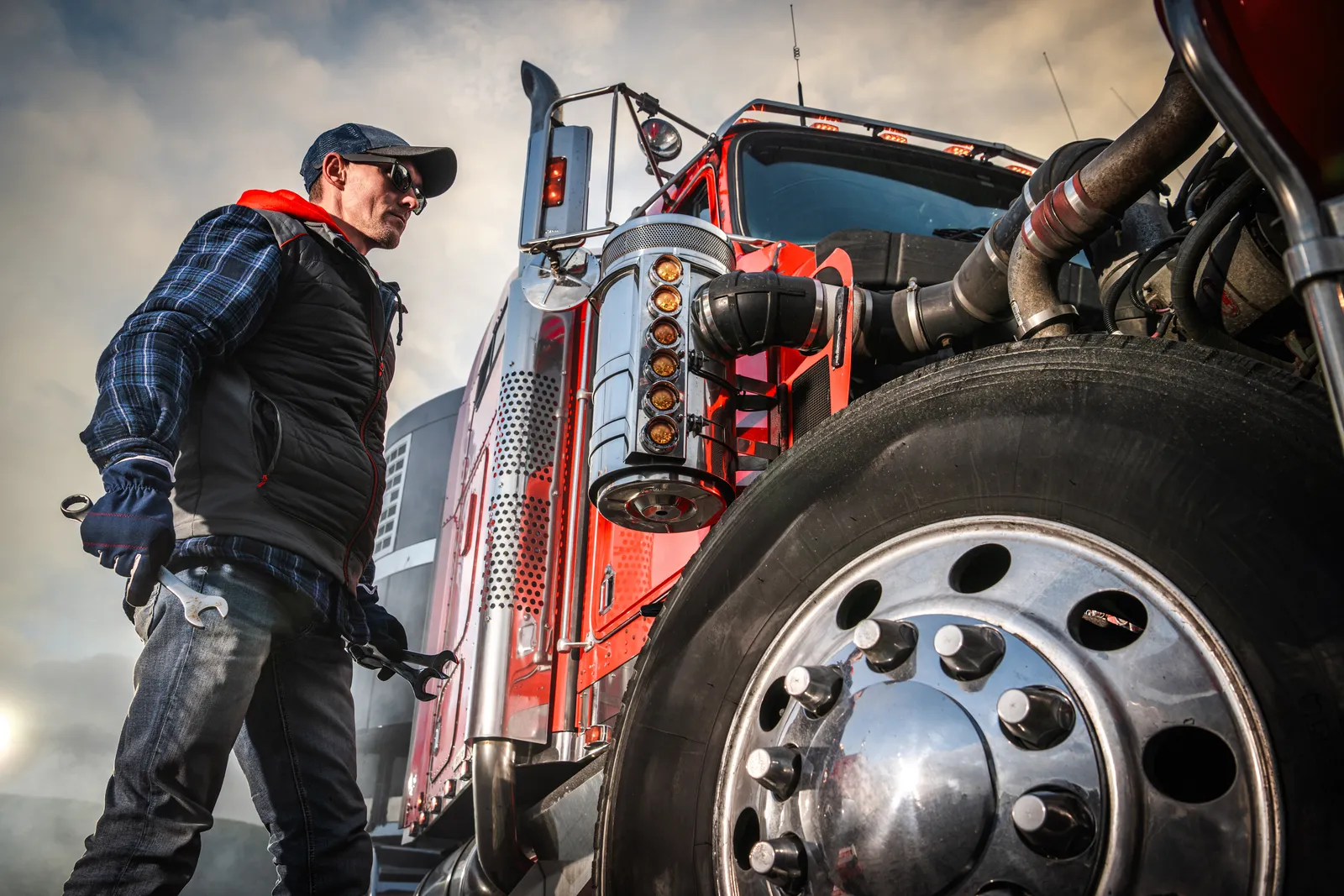
Commercial vehicle cases are won with evidence that ordinary car crashes simply do not have, because working vehicles and working drivers generate records constantly. The catch: nearly all of it lives in the business or company's hands, and much of it is routinely overwritten or discarded unless someone acts.
From the vehicle
Modern fleet vehicles are rolling data centers. Telematics record speed, braking, location, and driving behavior, minute by minute. Many fleets run forward-facing and driver-facing cameras. The vehicle's own damage tells a reconstructionist the story of angle and force. Every one of these sources can prove exactly what happened, and every one of them belongs to the other side.
From the company
The driver qualification file: application, background check, driving record, and what the company knew when it hired. Training records. Dispatch and route records showing the schedule the driver was running. Phone and app policies, and whether they were enforced. Maintenance and inspection records. Prior complaints about the driver. Post-crash internal reports. This is the paper trail that turns "an accident" into a case about choices.
From the scene and beyond
The crash report and officer's notes. Photographs of vehicle positions, skid marks, debris, and the company markings you captured. Traffic and business camera footage, often overwritten within days or weeks. Witnesses located while memories are fresh. The driver's cell phone records when distraction is suspected.
From your own life
Your medical records, consistently kept appointments, wage and tax documentation, and photographs of your injuries as they heal. The cost of this crash to your life is evidence too, and it deserves precision rather than an adjuster's imagination.
“Working vehicles keep records. The question is whether anyone makes the company keep them for you.”
Section 12
Mistakes That Damage Good Cases
Strong cases get weakened, and sometimes destroyed, by unforced errors that have nothing to do with the crash. Against a corporate defense team, avoiding them matters double.
- Talking to the company. The friendly call from a representative, the risk manager who "just wants to make this right," the recorded statement request. Every word becomes part of their file. Be polite, take names, and say nothing until you have talked to a lawyer.
- Saying "my lawyer told me..." Never open a sentence to a doctor, nurse, or anyone else with those words. A medical record quoting you that way becomes a defense exhibit suggesting a manufactured claim. Ask your own questions, the way any patient would.
- Letting anyone but you choose your doctors. Jurors distrust cozy lawyer-and-clinic referral pipelines, and insurers track them. The cleanest case is one where you found your own physicians and your treatment stands on its own. My office stays away from clinic referral relationships.
- Hiding your past. Prior crashes, claims, and injuries: the defense probably already knows through industry databases, and their questions are credibility tests. A lawyer who knows your history can almost always handle it; a concealed past, discovered, can end everything. I can work with the truth, not with surprises.
- Wage claims without wage proof. Lost income must be provable. Missing tax returns or off-the-books income can take that category off the table. Tell your lawyer the real state of your records early.
- Exaggerating, even a little. Commercial insurers hire investigators and run surveillance, and a claimant filmed doing what he swore he could not do has poisoned his whole case. Be accurate about good days and bad days: never minimize, never inflate. Lying to obtain insurance money is also a felony in Florida.
- Gaps in treatment, and social media. To an insurance company, if you were not treating, you were not hurting. Follow your doctors' guidance, keep appointments, and report every symptom. Until your case resolves: accounts private, nothing posted, no tags.
Section 13
Your Own Auto Insurance: Protect Yourself Before the Next Crash
This section may be the most valuable consumer advice in this guide, and it has nothing to do with hiring me. It is about a decision you can make this week that protects your family for years.
Pull out your auto policy's declarations page. It is the summary sheet listing each coverage and its premium. If you cannot find it, your agent or your insurer's app can produce it in minutes. Two line items matter most: your bodily injury liability limits and your uninsured motorist limits.
Liability limits protect what you own
Your BI liability coverage pays people you injure if you cause a crash, and it is what stands between a serious accident and your personal assets. It also obligates your insurer to provide you a legal defense. Minimal limits are exhausted quickly against today's medical costs. Increasing them usually costs far less than people expect. Ask your agent what higher limits would cost. You may be surprised.
UM coverage protects you from everyone else
I have said it throughout this guide and I will say it plainly here: uninsured and underinsured motorist coverage is, in my view, the single most important auto insurance a Florida family can buy. Florida does not require most drivers to carry bodily injury coverage, this state has one of the worst uninsured driver problems in the nation, and as this guide has shown, even a vehicle with a company name on the door is no guarantee that real coverage stands behind it. UM is how you protect yourself and your passengers from a driver, or a business, that has nothing.
- UM applies when the at-fault driver has no BI coverage, too little coverage, or cannot be found after a hit and run.
- UM covers you, resident family members, and passengers in your covered vehicle.
- It can pay medical expenses and lost wages beyond PIP, and pain and suffering where a permanent injury or death is involved.
Stack it if you can
Florida insurers must offer stackable UM coverage. Stacking combines the UM limits across the vehicles on your policy, multiplying your protection, and insurers may sell non-stacked coverage at a discount precisely because it pays less when you need it. If you insure multiple vehicles, ask specifically about stacked UM. It is one of the best values in insurance.
Section 14
Liens, Subrogation, and Paying Back Your Health Insurance
Here is a part of injury law that almost no one warns you about: when your case resolves, people will be standing in line for a share of your recovery. Handling that line well is a quiet skill that separates careful lawyers from careless ones, and it directly affects what you take home.
What subrogation means
Subrogation is the legal process of reimbursement. If your health insurance paid for crash-related care, your policy very likely contains language requiring it to be paid back out of any injury recovery. These repayment rights are called liens, and they are real, enforceable, and often governed by dense law.
- Private health insurance asserts contractual repayment rights, and employer-sponsored plans may be governed by a federal law called ERISA, which can change what reductions are possible.
- Medicare holds what is often called a super lien: a repayment right with priority over practically everyone, backed by federal law. Ignoring it risks penalties and loss of benefits, and lawyers and insurers can themselves be held liable for mishandling it.
- Medicaid and public hospitals have their own statutory lien rights in Florida.
- MedPay benefits may need to be repaid. PIP, notably, does not.
Use your health insurance
You may hear the suggestion, sometimes from clinics connected to referral services, that you should avoid using your health insurance so the medical bills in your claim look bigger. In my view that is a bad idea that mostly benefits the clinic. You have a duty to mitigate your damages, inflated balances invite scrutiny, and unpaid bills are your problem if the claim disappoints. After PIP is exhausted, submit your care to your health insurance. That is what it is for.
Why lien handling should shape your choice of lawyer
Too many attorneys treat liens as an afterthought and leave clients exposed, or leave money on the table that a proper negotiation would have recovered. Lien resolution is built into my evaluation of every case from day one: what will have to be repaid, what can be reduced, and what the client will actually receive. When you interview any lawyer, and I mean any lawyer, ask them directly how they handle Medicare and health insurance liens. The quality of the answer will tell you a great deal.
Wondering what liens might apply to your situation? That is exactly the kind of question a free consultation exists to answer: 941-499-1400.
Section 15
How a Case Moves From Start to Finish
Uncertainty is its own kind of suffering. Knowing the road ahead will not make your case move faster, but it will make the journey far less frightening. Here is how a Florida car accident case typically unfolds.
Investigation and treatment
First, the foundation: evidence is gathered and preserved, responsible parties and coverage are identified, and you focus on treatment. I do not push toward resolution until your doctors understand your condition and future needs, because settling before your injuries are understood means settling for less than your case involves. When a doctor places you at maximum medical improvement, valuation becomes possible.
The demand and pre-suit negotiation
In appropriate cases I present the insurance company a demand package: the evidence, the medicine, the losses, and a deadline. I keep pre-suit negotiation on a short, businesslike clock. Insurance companies sometimes use endless "evaluation" to drain time off your statute of limitations and learn your case for free. If good-faith progress is not happening, we do not linger.
Filing suit and discovery
A lawsuit is filed only with your express permission. Then both sides investigate each other's case through discovery. Expect the defense to obtain broad access to your medical history, take your deposition under oath, and likely have you examined by a doctor of their choosing. I prepare my clients thoroughly for each of these. Discovery is also where a commercial case pays for the early groundwork: corporate representatives sit for depositions, the driver's file and the company's policies come out, the telematics and video we preserved get analyzed, and the full coverage picture must finally be disclosed. None of it is pleasant. All of it is survivable, and preparation is the difference.
Mediation
Florida courts routinely require mediation: a confidential settlement conference guided by a neutral certified mediator. Nothing said there can be used later if the case does not resolve, which allows real candor. A large share of litigated injury cases resolve at or after mediation, once the insurance company has seen exactly what a jury will see.
Trial
If a fair resolution is not offered, your case is presented to a jury, typically of six people, through testimony, records, and exhibits. Trial is demanding, and it is also the entire source of a claimant's leverage. Insurance companies pay attention to lawyers who genuinely try cases. Roughly nine out of ten injury cases resolve without a verdict, but nobody can tell you in advance which case will be the exception. I prepare every accepted case as if it will be yours.
Section 16
Working With Me
What I do on an accepted case
Educate you about the process. Gather the crash report, medical records, and bills. Send preservation demands to the company and its insurers before the evidence disappears. Identify every responsible entity in the corporate structure and every layer of coverage, including your own policies. Interview witnesses and secure scene evidence. Work with your physicians to understand your condition and its permanency. Evaluate comparative fault. Identify and manage every lien. Negotiate with the insurers. Prepare you for deposition and depose the driver and the company's representatives. Retain the right experts. Mediate. And if fairness requires it, try your case to a jury.
The fee, in plain English
I handle injury and wrongful death cases on a contingency fee. You pay nothing up front and no fee unless there is a recovery. My fee is a percentage of the recovery, set out in a written agreement complying with the Rules Regulating The Florida Bar, and you receive the Bar's Statement of Client's Rights before you sign. Case costs are advanced by my office and reimbursed from the recovery. And I repeat my personal commitment: I do not take a fee that exceeds what my client receives.
I am selective, and that protects you
I decline far more cases than I accept. Selectivity is not arrogance; it is the only honest way to give every accepted client real personal attention, and it is consumer education you can use when evaluating any lawyer. The cases I accept generally involve:
- Serious injuries with objective medical evidence. Findings that can be independently verified: imaging, fractures, surgical findings, visible trauma. Purely subjective soft-tissue claims are handled well by other lawyers, and I am glad to refer you.
- Prompt medical treatment. People who are legitimately hurt see a doctor first, not a lawyer first. Juries feel the same way.
- Physician-based care. If your treatment also includes chiropractic care, that is fine; if it is exclusively chiropractic, I am likely not the right fit, and I will say so respectfully.
- Time to do the job right. I want months, not days, before the filing deadline. A claim brought to any lawyer at the last minute starts at a disadvantage.
What I ask of you
Complete honesty, always, in both directions. Stay engaged in your case and your treatment. Keep me updated on your health, your providers, and your contact information. Consider my advice seriously, even when we see something differently. And be the reasonable, credible person a jury can believe.
Section 17
Frequently Asked Questions
Can I sue the company, or just the driver?
Often both, and frequently others. When the driver was working within the course and scope of the job, the employer generally answers for the driver's negligence, and the company's own choices about hiring, supervision, maintenance, and entrustment can create direct responsibility on top of that. Florida's dangerous instrumentality doctrine may add the vehicle's owner. Who belongs in your case is an evidence question, and it is one of the first things I analyze.
The company says the driver was an independent contractor. Is my case over?
No. That label is a defense strategy before it is a fact, and courts look at the reality of the relationship, especially who controlled the work, not just what the paperwork says. Even where the label holds, other theories and other parties may remain. Do not accept that sentence from an adjuster as a legal ruling. It is not one.
A company representative already called me, and they seem eager to settle. Why?
Speed serves them twice: a quick settlement closes their exposure before the full extent of your injuries is known, and early friendly contact often produces statements their file can generally use later. You lose nothing by getting an independent, free evaluation before you respond, and you cannot undo a signed release.
The van that hit me had no company markings. What now?
Unmarked does not mean uninsured or unconnected. Registration records, the crash report, telematics subscriptions, and the driver's own employment can reveal the business behind a plain white van. This is investigative work, and it is exactly what early legal help is for.
How is this different from a truck accident case?
Large trucks bring an entire body of federal motor carrier law, and my Florida Truck Accident Guide covers that world in depth. This guide covers the far more common collisions with the working vehicles around us: vans, service trucks, fleet cars, and delivery vehicles. The corporate-defendant dynamics are similar; the regulatory details differ. Either way, the first moves are the same: get medical care, preserve evidence, and say nothing to their insurer.
What if I was hit by a rideshare or delivery-app driver?
Coverage in app-based cases can change by the minute, depending on whether the driver was waiting for, en route to, or performing a ride or delivery. Florida's rideshare law requires $1,000,000 in coverage during rides, with lower requirements at other stages, and delivery platforms carry their own structures. Florida law also shields the rideshare companies themselves from direct claims in most instances, and they are not treated as common carriers, so you may have to pursue the individual driver, whom the rideshare company insures. These cases are document fights about status and timing, and they are winnable with the right records.
Can I afford a lawyer for a fight against a company?
Yes. Contingency representation means nothing up front, costs advanced by my office, and no fee unless you recover. The size of the defendant changes nothing about that, and the consultation is free.
What if I was partly at fault?
Partial fault reduces recovery by your percentage, and more than 50 percent bars it entirely under current Florida law. Corporate defense teams work hard to build that percentage. Do not accept their version of it. Fault is a legal conclusion built from evidence, and this question deserves professional eyes before you make any decision.
How long will my case take, and what is it worth?
The honest answers: it depends on your medical recovery and whether suit is required, and anyone quoting a value before understanding your facts, your medicine, and the coverage picture is guessing. No lawyer can ethically promise a result. What I promise is an honest evaluation, real preparation, and a fight for full, fair compensation.
What should I do next, today?
Get the medical care you need. Preserve what you can: photos of the vehicles and company markings, documents, names. Stay off social media. Sign nothing and give no statements to the company or its insurer. Then call me and let's talk through the rest, one step at a time: 941-499-1400.
Section 18
Let's Talk. Let's Win.®
You now know how commercial vehicle claims actually work: the corporate playbook, the layers of coverage, and the evidence that decides these cases. You can face the company's team alone, or you can have a trial lawyer who has spent three decades in these fights standing beside you. When you hire me, you get me: my attention, my preparation, and my complete effort.
Free consultation. No obligation. No fee unless you recover.
Underdogs Welcome.®
941-499-1400David Harris Law, P.A. • 871 Venetia Bay Blvd, Suite 223, Venice, FL 34285 • harris.lawyer • Monday through Friday, 9 a.m. to 5 p.m.
What to expect on your first call
- You talk with my office about what happened, in your own words
- Have handy what you can: crash report, photos, insurance cards, medical papers. Missing items are fine
- I listen first, then give you my honest assessment, including hard truths
- You will learn your deadlines and immediate next steps, whether or not we work together
- No cost, no obligation, and absolutely no pressure to sign anything
- If your case is not for my office, I will point you toward lawyers who fit
David Hughes HarrisMay God bless you and keep you on the road to recovery.
Your David To Fight Your Goliath® • Let's Talk. Let's Win.® • Underdogs Welcome.®
Prefer this guide as a free PDF?
Get the complete, printable 24-page Florida Commercial Vehicle Accident Guide to read offline or share with your family.
Get the Free GuideImportant Information About This Guide
Thank you for reading The Florida Commercial Vehicle Accident Guide. Before you go any further, there are a few things you deserve to know about what this guide is, and what it is not.
This guide is general information, not legal advice
Everything in these pages is offered as general consumer education about Florida crashes involving commercial and company vehicles. It is not legal advice about your specific situation. The law is applied to facts, and your facts are unique. Nothing in this guide should be relied upon as a substitute for a direct conversation with a licensed attorney about your own circumstances.
Reading this guide does not make me your lawyer
No attorney-client relationship is created by reading this guide, calling my office, or sending an inquiry. An attorney-client relationship with David Harris Law, P.A. begins only when you and I have both signed a written representation agreement. Until that happens, please do not send confidential information.
No promises about outcomes
This guide describes how the claims process generally works. It does not promise, predict, or imply any result in your case. No honest lawyer can ethically guarantee an outcome, and you should be cautious with anyone who does.
This is not medical advice
Where this guide discusses injuries and medical care, it does so only to explain how health issues intersect with a legal claim. Decisions about your health belong to you and your doctors. If you have been hurt, please seek appropriate medical care promptly and follow your doctors' guidance.
Deadlines are real, and companies move fast
Florida law generally allows two years for most negligence claims arising on or after March 24, 2023, and some notice requirements come even sooner. In commercial vehicle cases there is a second clock that matters just as much: the company's insurance team often begins working the file within hours of the crash, and fleet vehicles get repaired and put back on the road quickly. If you take only one thing from this page, let it be this: do not wait to get answers.
Attorney advertising
Attorney advertising material. The hiring of a lawyer is an important decision that should not be based solely upon advertisements. Before you decide, ask us to send you free written information about our qualifications and experience. David Harris Law, P.A., 871 Venetia Bay Blvd., Suite 223, Venice, FL 34285. 941-499-1400.
David Harris Law, P.A. 871 Venetia Bay Blvd, Suite 223, Venice, FL 34285 941-499-1400
Copyright © David H. Harris. All Rights Reserved. • David Harris Law, P.A. • 871 Venetia Bay Blvd, Suite 223, Venice, FL 34285 • 941-499-1400 • harris.lawyer